Blog
The Ultimate Naples 6 Step Guide to Hurricane Storm Prep for Your Boat in Southwest Florida
| Sep 08, 2026 | Uncategorized
The Ultimate 6 Step Guide to Hurricane Storm Prep for Your Boat in Southwest Florida
For boat owners in Southwest Florida, hurricane season is an inevitable reality. When a named storm enters the Gulf of America, the window to secure your marine investments closes rapidly. Whether your vessel is docked in Naples, Marco Island, Estero, or Bonita Springs, having a comprehensive storm prep strategy is not just recommended—it is essential for the survival of your boat and the safety of the surrounding waterways.
As professional boat detailers, we have seen firsthand the difference between a boat that weathers a Category 4 hurricane and one that becomes a total loss. The difference does often come down to luck but without preparation, luck will not be your lady.
This guide details steps every boat owner must take to prepare their vessel for hurricane-force winds and devastating storm surges.
Why Proactive Marine Storm Prep Matters
Search engines and marine authorities alike agree: preparation is the only defense against a hurricane. The coastal geography of Southwest Florida makes our local waterways particularly vulnerable to rapid storm surge and high-velocity wind funnels. According to the National Oceanic and Atmospheric Administration (NOAA) https://www.noaa.gov/ , storm surge is often the greatest threat to life and property along the coast. For marine boats, this surge—combined with 100+ mph winds—can snap standard dock lines, flood hulls, and rip off aftermarket accessories.
To protect your vessel, you must systematically reduce its “windage” (the surface area exposed to the wind) and secure its physical connection to the earth or dock. Here are some steps to prep your boat before the storm hits.
5 Critical Steps for Hurricane Boat Preparation in Southwest Florida (Naples, Marco Island and Bonita Springs)
- Strip the Canvas: Remove Boat Covers and Bimini Tops
One of the most common mistakes boat owners make is leaving their boat covers, bimini tops, and sails attached. In a severe storm, canvas acts like a parachute. Hurricane-force winds will quickly catch under boat covers, creating immense upward pressure.
Not only will the wind shred expensive custom canvas, but the force can also bend the stainless-steel framing, damage the deck hardware, or even contribute to pulling the boat completely off its lift or moorings. Strip all canvas components entirely and store them securely indoors.
- Clear the Deck: Remove Seat Cushions and Loose Gear
If it can be removed without a wrench, it needs to come off the boat. The winds experienced in Naples and Marco Island during a major hurricane can easily turn loose marine gear into dangerous projectiles.
- Remove all seat cushions: Even heavy marine cushions will blow away. If they get waterlogged and trapped in the boat, they can block scuppers and drainage holes, causing the boat to fill with water and sink.
- Stow all loose items: Antennas, life rings, deck chairs, fishing gear, coolers, and decorative items must be removed.
- Clear the scuppers: Ensure all drainage areas are completely free of debris so that torrential rain can exit the hull quickly.
- Safeguard Your Tech: Pull Off Removable Electronics
Marine electronics are sensitive, expensive, and highly susceptible to water intrusion when wind drives rain sideways at 120 mph.
Carefully disconnect and remove all removable GPS units, fish finders, VHF radios, and digital displays. Wrap the exposed marine connectors on the helm tightly with electrical tape and heavy-duty plastic bags to prevent salt and moisture from corroding the wiring harnesses while the storm passes.
- Secure the Hull: Boat Elevation Strategies
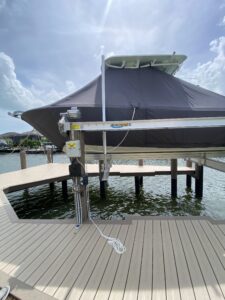
If your boat is kept on a lift in Naples, Estero, Bonita Springs or Marco Island, elevation is your best defense against storm surge—but it must be executed correctly.
- Raise the Lift: Elevate the boat as high as safely possible to avoid the anticipated storm surge. Keep in mind that storm surges in Southwest Florida can easily exceed 8 to 12 feet in severe scenarios.
- Remove the Drain Plug: When the boat is elevated and out of the water, you must remove the drain plug. A hurricane will dump massive amounts of rain into the hull. If the plug is left in, the accumulated water will easily exceed the weight capacity of your boat lift, causing the lift cables to snap and dropping the boat.
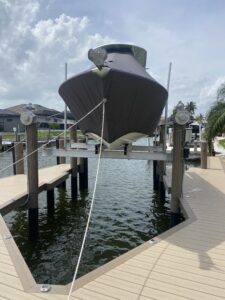
- Tie the Boat to the Pilings: Do not rely solely on the lift to hold the boat. Use heavy-duty lines to tie the boat directly to the sturdy pilings of the lift structure to prevent the boat from floating far off the bunks if the surge rises above the lift platform. There should be the proper amount of slack in the line, so the boat can float, but not too much slack that when the water recedes, the boat does not end up resting in an improper position in the cradle.
- Master the Lines: Proper Tie-Downs from the Boat to the Dock
- If possible, have your boat pulled from the water and stored and on land.
There are marinas and boat service locations that will pull your boat from the water and store it on land. Some locations may have room to store it indoors. Pre-planning with one of those providers is huge. Do not wait till there is a storm as space is very limited. One such place is Naples Bay Yacht Stowage
If your boat must remain in the water, proper dock tie-downs are the only thing keeping it from ending up in the mangroves. Standard docking lines are severely insufficient for hurricane conditions.
Account for Tidal Surge: Tie lines high on the pilings. You must leave enough slack in the lines to allow the boat to rise with a massive storm surge, but not so much slack that the boat can repeatedly smash into the dock.
Professional Storm Prep Services for Your Vessel:
Preparing a boat for a major hurricane is incredibly labor-intensive and time-consuming, especially when you are also trying to secure your home and family. For boat owners in Bonita Springs, Estero, Naples, and Marco Island, not only do we offer our boat detailing services but we also we offer Storm Prep Services.
By retaining us on a storm prep contract, you guarantee that our marine professionals will arrive at your vessel ahead of the storm to execute all of the vital steps listed above—from stripping the canvas to securing dock tie-downs.
An Important Financial Note: Many marine insurance companies recognize the immense value of professional storm preparation. Depending on your specific carrier, having a formal storm prep service contract in place may qualify you for insurance premium reductions. We highly recommend contacting your insurance provider to see if our professional mitigation services can lower your annual premiums.
Relying on Marine Authorities
When a storm approaches the Florida coast, staying informed through authoritative marine sources is vital. We recommend bookmarking the following resources for the latest navigational and weather safety updates:
- [U.S. Coast Guard Navigation Center] (http://navcen.uscg.gov) – For local notices to mariners and port closures.
- [Florida Fish and Wildlife Conservation Commission (FWC)] (Link to myfwc.com) – For updates on post-storm waterway debris and localized boating restrictions.
- [BoatUS Hurricane Resource Center] (http://boatus.com/hurricanes) – For additional macro-level strategies on protecting your marine investment.
A hurricane does not have to mean disaster for your boat. By taking professional, methodical steps to strip canvas, stow cushions, protect electronics, manage elevation, and secure tie-downs, you drastically increase your vessel’s chances of survival. Whether you tackle these steps yourself or rely on our expert storm prep services, do not wait until the cone of uncertainty is pointing directly at Southwest Florida. Secure your vessel, protect your investment, and stay safe.
Thank you for the information. Love to get some boat detailing options from you. Im in Naples.